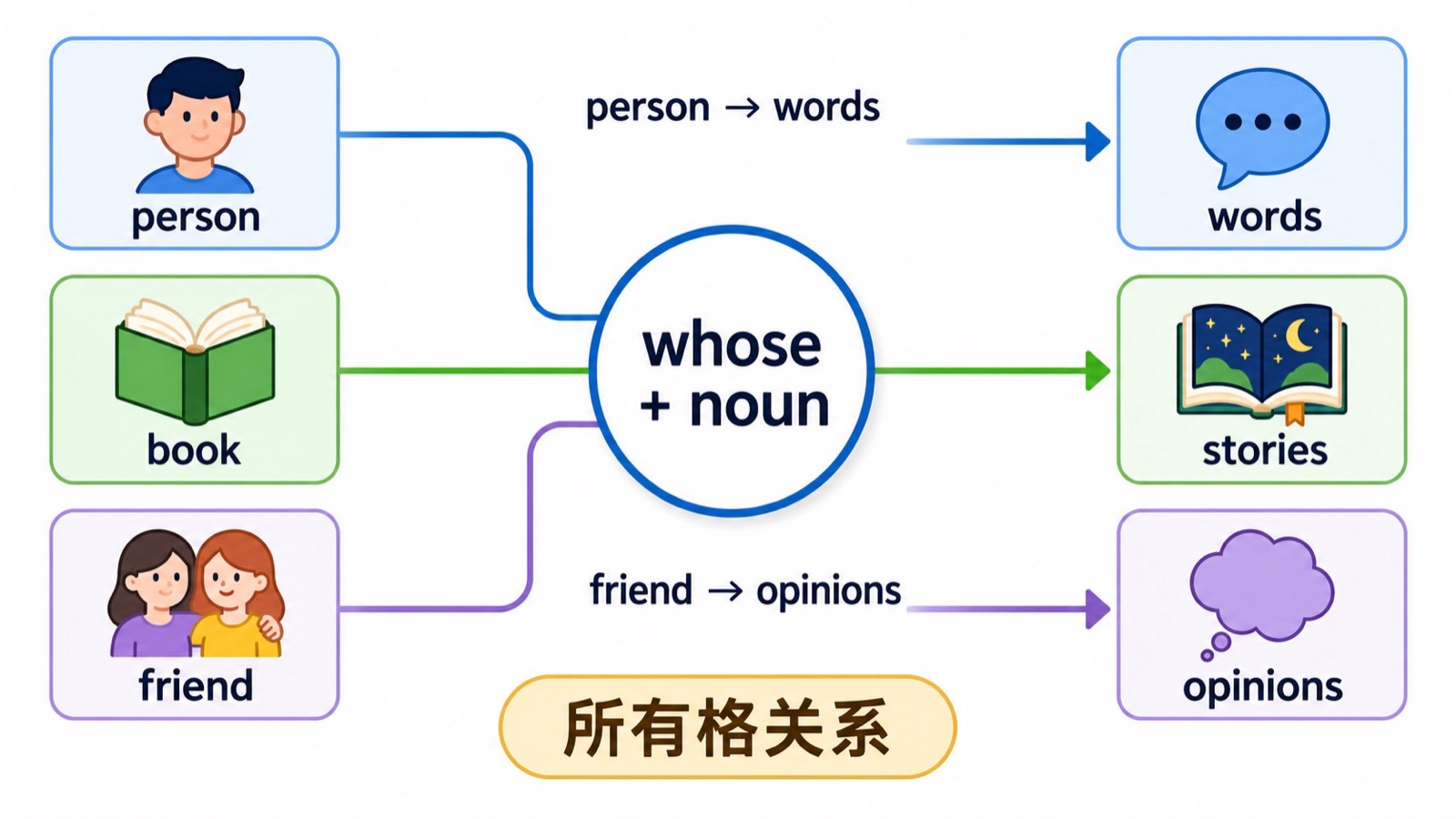
whose 定语从句不是把 whose 简单翻译成“谁的”。它真正解决的是“某人的话、某本书里的故事、某个朋友的观点”这种所有格关系。最稳的框架是:先说你要介绍的人或物,再用 whose + 名词 接上属于它的内容,例如 There is a person whose words you should listen to.
whose 在定语从句里到底表示什么?
whose 在定语从句里表示“所属关系”。它后面通常要带一个名词,形成一个整体:
whose words
whose stories
whose opinions
whose lessons
你可以把它理解成:
whose + noun = 前面那个人或物的某个东西比如:
There is a person whose words you should listen to.
有一个人,他的话你应该听。
这里的 whose words 不是一个孤立的“谁的”。它在说:前面这个 person 的 words。
再看一个:
There is a book whose stories will touch you.
有一本书,里面的故事会打动你。
这里 whose stories 指的是前面这本 book 里的 stories。Cambridge Grammar Today 和 British Council 都把 whose 归入关系词体系,用来表达所有格或所属关系。下面的例子用于帮助理解场景,语法事实以这些权威资料为准。
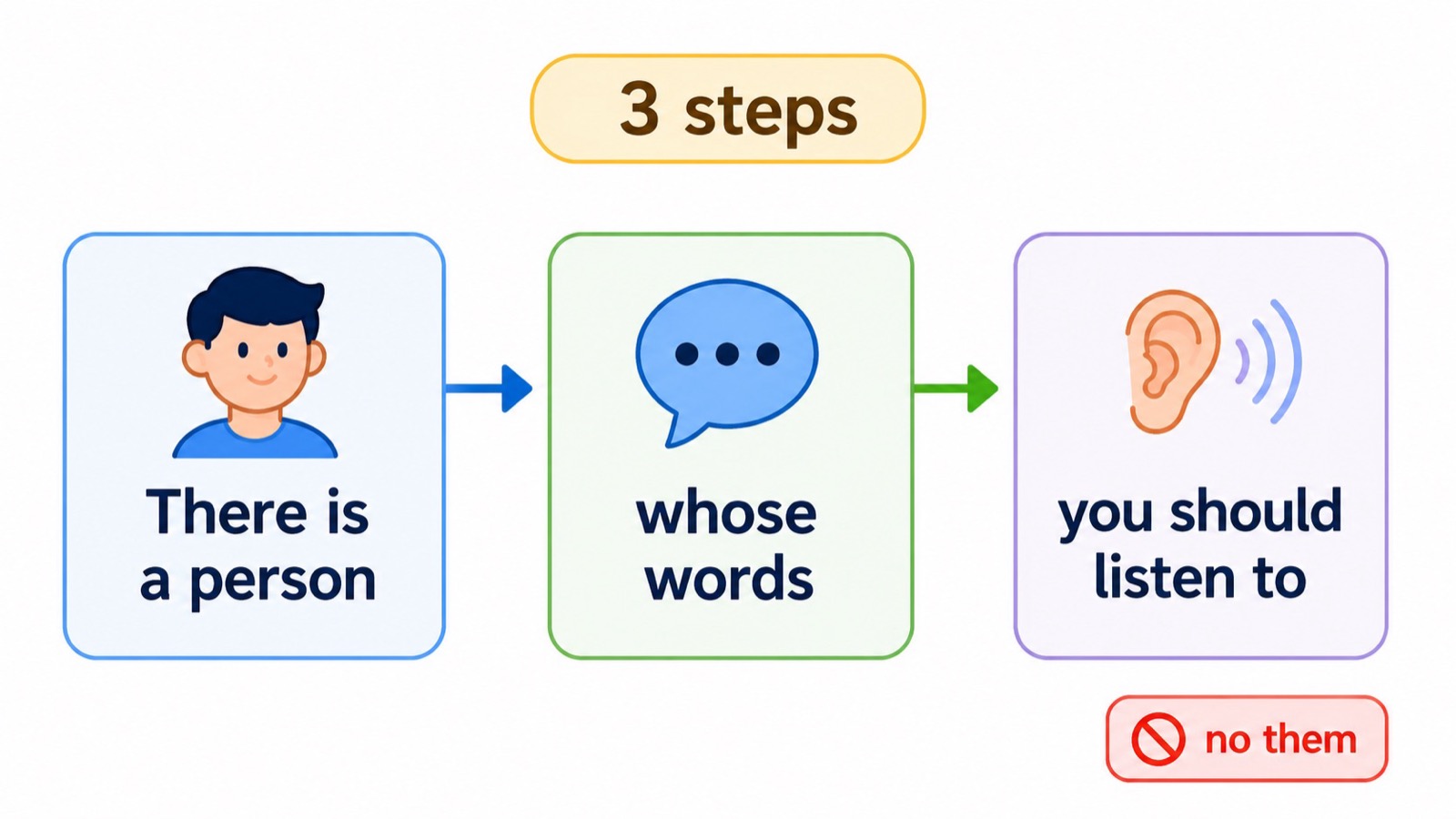
3 步把中文“某人的话”改成 whose 从句
不要从中文词序硬翻。按这 3 步来。
第 1 步:先说主句里的对象
中文是:
有一个人的话你应该听。先只说“有一个人”:
There is a person.第 2 步:找属于这个对象的名词
问自己:后面讲的是这个人的什么?
这个人的话
his words
在定语从句里,把 his words 改成:
whose words第 3 步:把动作接到 whose + noun 后面
“你应该听他的话”可以拆成:
You should listen to his words.合并时,his words 已经变成 whose words,所以不要再重复:
There is a person whose words you should listen to.错误常出现在这里:
Wrong: There is a person whose words you should listen to them.
Right: There is a person whose words you should listen to.
whose words 已经在从句里承担了 listen to 的对象关系,后面不要再补 them。
再用 3 个场景练一遍
一本书里的故事
中文:
有一本书里的故事会打动你。先找对象:
There is a book.再找属于它的名词:
its stories -> whose stories最后合并:
There is a book whose stories will touch you.注意,这里不要写成:
Wrong: There is a book which stories will touch you.
Right: There is a book whose stories will touch you.
which 可以指物,但它不等于“这本书的”。你要表达“书的故事”,就需要所有格关系。
一个朋友的观点
中文:
有一个朋友的观点你应该重视。英语可以说:
There is a friend whose opinion you should value.如果是多个观点:
There is a friend whose opinions you should value.这里 whose opinion 或 whose opinions 取决于你想说一个观点还是多个观点,不取决于 friend 本身。
一个老师的课
中文:
有一个老师的课你应该认真听。可以说:
There is a teacher whose lessons you should take seriously.如果你想强调某一节课:
There is a teacher whose lesson you should take seriously.判断时看 whose 后面的名词。lesson 是单数,lessons 是复数。
whose 和 who、which、that 怎么区分?
先别背一堆术语。问自己:后面的从句缺的是什么关系?
| 你要表达的关系 | 常用关系词 | 例句 | 判断 |
|---|---|---|---|
| 人做了某事 | who / that | There is a person who can help you. | 后面缺“人”这个主语 |
| 物被提到或被使用 | which / that | There is a book that you should read. | 后面缺“书”这个宾语 |
| 某人的或某物的某个名词 | whose | There is a person whose words you should hear. | 后面缺“这个人的话” |
对比最清楚的是这组:
There is a person who can help you.
有一个人可以帮你。

There is a person whose words can help you.
有一个人的话可以帮你。
第一句说的是“这个人能帮你”,所以用 who。第二句说的是“这个人的话能帮你”,核心名词变成了 words,所以用 whose words。
再看 book:
There is a book that you should read.
有一本书你应该读。

There is a book whose stories you should read.
有一本书里的故事你应该读。
第一句里 book 是你要读的对象。第二句里你要读的是这本书里的 stories,所以用 whose stories。
不要把 whose 写成 who words
中文学习者很容易写:
Wrong: There is a person who words you should listen to.错因很简单:who 只能把“人”接进从句,不能直接放在名词 words 前面表示“人的话”。这里要用所有格关系:
Right: There is a person whose words you should listen to.同理:
Wrong: a writer who books are popular
Right: a writer whose books are popular

Wrong: a book which title I forgot
Right: a book whose title I forgot在比较正式的英语里,whose 也可以用于物,尤其像 a book whose title... 这种结构。日常口语里,如果你觉得这种写法太书面,也可以改写成更简单的两句:
I forgot the title of the book.
The book has stories that will touch you.
SEO 文章里要讲清规则,但练口语时,能自然表达也很重要。
whose 和 who’s 不是一个词
whose 表示“谁的、某人的、某物的”这种所属关系:
Whose book is this?
There is a writer whose books are popular.
who's 是 who is 或 who has 的缩写:
Who's there?
Who's finished the exercise?
所以不要写:
Wrong: Who's words should I listen to?
Right: Whose words should I listen to?
如果后面紧跟名词,比如 words、book、opinion、lesson,你大概率要的是 whose,不是 who's。
和 where 从句怎么配合学习?
where 和 whose 都可以引导定语从句,但它们解决的问题不同。
where 解决地点关系:
This is the city where I was born.whose 解决所有格关系:
There is a person whose words you should listen to.所以不要把所有从句都套成一个模板。你可以按这两个问题判断:
| 问题 | 用哪个 |
|---|---|
| 动作发生在哪里? | where |
| 讲的是前面那个人或物的某个名词? | whose |
如果你还不熟 where,可以先看 where 从句怎么用,再回来练 whose。两个页面合起来,刚好覆盖“地点关系”和“所有格关系”这两类最常见的中文转换卡点。
用 Video Language Learn 练 whose 句子
读懂规则之后,不要只停在看解释。你可以把上面的句子放进真实视频学习流程里练 3 遍。
第一遍,用单句循环反复听这一句:
There is a person whose words you should listen to.第二遍,做全句听写,重点检查这三个位置:
There is a person / whose words / you should listen to第三遍,影子跟读并替换名词:
There is a book whose stories will touch you.
There is a friend whose opinions you should value.
There is a teacher whose lessons you should take seriously.
练习目标不是背下定义,而是听到中文“某人的、某本书的、某个老师的”时,能自然反应出 whose + noun。
4 组替换练习
先看中文,自己写英文,再对答案。
| 中文 | 推荐英文 |
|---|---|
| 有一个人的建议你应该考虑。 | There is a person whose advice you should consider. |
| 有一个作家的书很适合初学者。 | There is a writer whose books are good for beginners. |
| 有一个朋友的消息让我很开心。 | There is a friend whose message made me happy. |
| 有一家公司,它的产品改变了很多人的学习方式。 | There is a company whose product changed the way many people learn. |
最后再做一个自检:
whose 后面有没有名词?
从句里有没有重复 his / her / its / them?
这句话讲的是“谁做了某事”,还是“谁的某个东西”?
这 3 个问题能帮你避开大多数 whose 定语从句错误。
FAQ
whose 后面一定要接名词吗?
在定语从句里通常要接名词,例如 whose words、whose books、whose opinion。因为 whose 表示所有格,它要告诉读者“前面那个人或物的什么东西”。
whose 可以指物吗?
可以。whose 最常见的是指人或动物,但在较正式的表达里也可以指物,例如 a book whose title I forgot。如果你觉得这种句子太书面,也可以改成 the title of the book 这类结构。
whose 和 who 最大区别是什么?
who 指人本身,whose 指这个人或物的某个名词。a person who can help you 是“一个能帮你的人”;a person whose words can help you 是“一个人的话能帮你”。
whose 和 that 能互换吗?
不能机械互换。that 可以指人或物,但通常不表达所有格关系。a writer that books are popular 不自然,应该说 a writer whose books are popular。
参考资料
- Cambridge Dictionary, English Grammar Today: Relative pronouns
- Cambridge Dictionary, English Grammar Today: Whose
- British Council LearnEnglish: Relative pronouns and relative clauses
Practice Next
把这套方法放进一个真实视频里练
学习指南的价值不在收藏,而在马上完成一次训练。选一集真实英文视频,从盲听、逐句精听、跟读或听写开始。